
Blog
An Open Letter to Public Transport
4 mins
Reading Time

I have always had an incredibly complex relationship with public transport.
As a young child, I remember hating it for so many reasons. Having OCD (but also not knowing I did), I had a deep fear of contamination and that the bus was dirty (because, well… often it is). I hated the proximity that I had to be to strangers, I hated the noise, I hated the abrupt stopping, I hated the inability to know exactly when it would stop, and I hated the idea that a stranger was in charge of a vehicle that I was in. I felt unsafe, and constantly feared that something indescribably awful would happen. I worried that we would crash, that we would break down in the middle of the busiest road, that fights would break out, that I’d be attacked, or that I’d catch a highly infectious and deadly disease.
Long story short, I hated using public transport. When I did, it was only out of necessity. The fact that people relied on it to get about seemed incomprehensible, and I’d certainly have never pictured it for me - which I now can see is indicative of my inherent privilege.
I remember at the ripe old age of (approximately) 10 spending my Saturday morning writing a persuasive letter to my dad about why we should take the car as opposed to the bus after he suggested we catch the bus to my grandparents’ house (yes, we had been practicing persuasive essays at school that week). Needless to say, when it worked, I remember being so incredibly relieved.
I also remember a school excursion in year 5 where we had to take public transport instead of using a school bus. I ‘sat’ awkwardly crouching on the edge of the seat and wanting badly to escape. To be fair, I also didn’t like school buses but at least those I was familiar with.
In high school I rarely left the house, so it was much less of a concern. I could catch the bus if I needed to (at a stretch) and I did a few times (usually not by myself though). I still would avoid it at all costs because it felt so uncomfortable. Most of the time I was fortunate to be taxi-ed to and fro by my mum.
When I started learning to drive, mental health challenges became an overwhelming presence in my life to a degree that made driving inaccessible and unsafe. It was one of the many things that I missed developmentally. Instead of sitting through driving lessons I was sitting through appointments and confined to a hospital bed. Independence was a foreign concept, and there was no use even thinking about driving when I wasn’t allowed to use the toilet without being supervised.
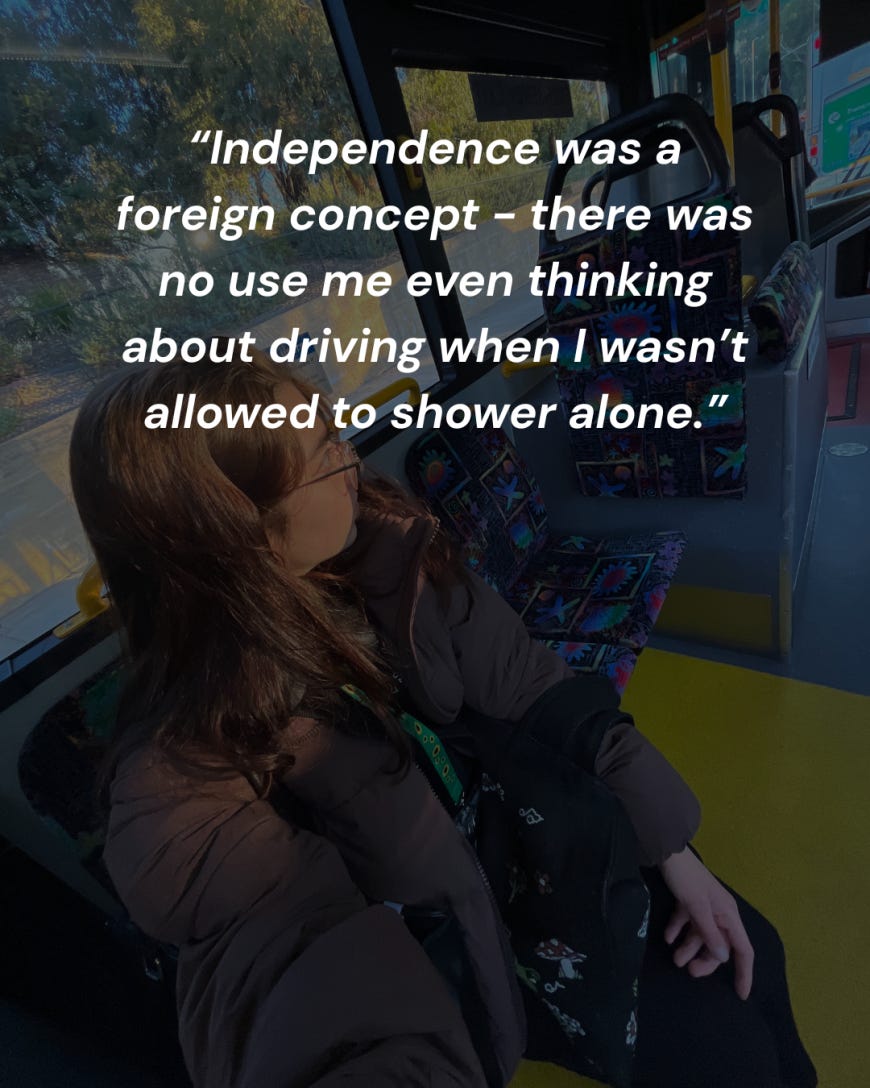
Even after my the darkest stages of my mental ill-health, the only places I went were appointments to which I’d be driven. I had essentially given up on the idea of driving and figured I’d just spend my life locked in my room, only going out for work (which my mum would drop me at). The idea of catching the bus continued to become more frightening and before I knew it years had passed without me taking one.
But gradually, I started to want a different life - one with more independence. Let me be clear, this was not overnight. There was no ‘lightbulb moment’. Frankly, I am still far from a place that I would consider myself to have the independence that I’d imagined I’d have at 22 (and had I not gone through what I have)
But I can remember a time in the car park of a clinipath after getting my fortnightly blood test. I remember becoming so acutely aware of how restricted I was by my mental ill-health and - for the first time - I started to want change. This change was uncomfortable and felt completely foreign - it took most of my time and capacity. Driving still didn’t appeal to me and didn’t even rank amongst my priorities, hence it was still on the back-burner.
But alas, the wheels of life kept turning and my progress (i.e. the wheels of my car) did not. I reluctantly started taking the bus again, with the caveat that as soon as I had the mental space to get back to driving, I would.
What’s surprised me is that the bus (and in effect the world) has become more and more accessible for me the more I’ve taken it. It’s been through taking the bus that I have also been more okay with travel - I credit the repeated exposure to the bus (something I genuinely feared) that has enabled me to travel. That has allowed me to say ‘yes’ to opportunities like travelling to Melbourne… then Adelaide, then Port Hedland, then Sydney, then Kuala Lumpur!! Something I NEVER would have imagined in my wildest dreams, even as recently as a year ago.
Over the last year and a half, it’s been a gradual process - reluctance to discomfort then acceptance and now some degree of peace. Almost without realising, I've transitioned from having to force myself to get on the bus and battle the overwhelming urge just to cancel my plans and stay home, to now actually not hating the bus ride. I would never admit it aloud, but sometimes I actually look forward to my bus time, because it’s nothing but me, my headphones, and my Google Docs. I have found an ability that I never though I’d have - time to reflect and to exist alone (ironic I know, as it’s probably one of the times I’m most surrounded by people).
I spend my bus trips writing. It’s time that I can rely on that isn’t disrupted.
In fact, I’m writing this on the bus right now. Yep, picture me sat on a seat typing away on my phone. Having to stop periodically to switch buses and check if I’m almost at my stop, but besides that I completely enter my own world.

I’ve found a way to make it work for me, and in doing so I’ve found the independence I never thought I’d have
…so I suppose, to the bus I say thank you. For pushing me, for testing me, and for finally becoming an accessible option. For giving me freedom not just in my day-to-day life, but also so much more broadly.
- Rachael, a certified (by SmartRider) ‘bus girlie’.
Join the Ingetrity Army
Be apart of our growing team

